Snoopers and thieves can easily access
files and passwords on your computer, even without your Windows
password. All they have to do is insert a special disc (such as UBCD4Win or Hiren's BootCD)
into your computer and power it up. The computer will then boot from
the operating system on the disc, bypassing the Windows operating system
installed on the PC--and any passwords you’ve set--and giving the
intruders access to your hard drives.
If you want to protect your computer from this type of attack, you
have to encrypt the files that you don’t want others to be able to
access. That's why we're going to show you three different methods for
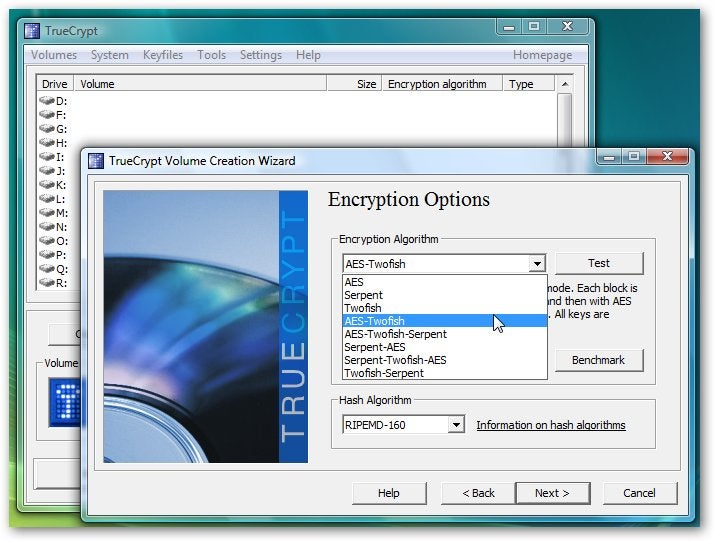
using encryption tools on your PC. If you're looking to encrypt only a few sensitive documents, we recommend using TrueCrypt, which lets you create virtual encrypted disks where you can protect select files. Read "How to Use TrueCrypt to Encrypt Your Sensitive Documents"
for a step-by-step explanation of how to set up a basic virtual
encrypted disk that will make your important files unreadable to prying
eyes. On
the other hand, in case your work PC's data is important enough that
you want to encrypt the entire hard drive, we'll show you how to do
that, too. Windows 7 and Windows Vista's Ultimate and Enterprise
editions include a feature called BitLocker that can encrypt whole hard
drives, right down to the system files and password caches.
If you want full drive encryption but don't have Windows in its
Ultimate or Enterprise flavor, don't worry. We'll also walk you through
the process of using the third-party DiskCryptor
utility to encrypt your whole hard drive--and you (probably) won't have
to reformat to get started. What's more, it's absolutely free.
Researchers from German security
firm Recurity Labs have released a JavaScript implementation of the
OpenPGP specification that allows users to encrypt and decrypt webmail
messages.
Called GPG4Browsers, the tool functions as an extension for Google Chrome and now is capable of working with Gmail.
According to its developers, GPG4Browsers is a prototype, but it supports almost all asymmetric and symmetric ciphers and hash functions specified in the OpenPGP standard.
The
OpenPGP specification uses public key cryptography to encrypt and
digitally sign messages and other data. It is based on the original PGP
(Pretty Good Privacy) program and is most commonly used for securing
email communications.
Setting up a PGP variant to work with a
particular email client on a local computer can prove troublesome for
less technical users, not to mention that it's not portable. A PGP user
who wants to send and receive encrypted emails from a different
computer, would have to install it on that system first, import his
private and public keys into the local database, known as the keyring,
and then configure his email client.
The benefits of a JavaScript-based implementation that runs inside the browser is that it
doesn't require a dedicated email client or other software installed on the computer.
At
the moment, GPG4Browsers only works in Google Chrome and is not
available for download from the Chrome Web Store. However, if the name
is any indication, the extension will be ported to other browsers in the
future.
Users interested in giving it a try must download it
manually and install it as an unpacked extension. This can be done from
the Tools > Extension page by checking the "Developer mode" box and
clicking on "Load unpacked extension."
The
current release is limited by the fact that it cannot generate private
keys, although the menu for doing this is present, so the feature will
most likely be implemented in the future.
Importing public and
private keys works fine and when browsing on Gmail a black lock icon is
displayed in the address bar. Clicking on it will open a dialog for
composing an encrypted or a digitally signed message.
Similarly, when an encrypted
message arrives in the Gmail inbox, the browser asks users if they want
to open it with GPG4Browsers. The extension can decrypt messages signed
with GnuPG (GNU Privacy Guard), a popular open source PGP
implementation, but only if data compression isn't used.
The
GPG4Browsers source code is available under a GNU Lesser Public License
so the tool can be easily improved to support additional webmail
providers. The developers also provide documentation which explains the available APIs.
An
OpenPGP JavaScript implementation offers convenience and portability,
but also has some downfalls. "Since memory-wipe of private data and
validation of a secure execution environment cannot be achieved in
JavaScript this implementation should not be used in environments where
the confidentiality and integrity of the transmitted data is important,"
the developers warned.
This means that GPG4Browsers shouldn't
probably be used on a computers system when there's reason to believe
that it might be infected with malware or compromised or in some other
form. However, in such cases the user can always boot from a live Linux
CD or a similar read-only environment.
Samsung on Sunday introduced two new models of its
flagship Galaxy smartphone line at the annual gala for the mobile
world, the Mobile World Conference in Barcelona, Spain.
Both phones have similar features, but one, the Galaxy S7 Edge, has a 5.5-inch display, the same size as the iPhone 6s Plus.
The units have curved screens that support quad HD resolution, as
well as a slight curve on the back, making them easier to hold.
To soothe complaints about the battery life of the previous Galaxy
generation, the units have received power boosts. The S7 Edge has a
3,600-mAh battery, a jump from the S6 Edge's 2,600, and the S7 has a
3,000-mAh power supply, while the S6's battery was only 2,550.
In addition, the units are water and dust resistant, support microSD storage, and run on Android 6.0 Marshmallow.
Fewer Megapixels
Samsung also has made some changes in the Galaxy's camera. It has
reduced the number of megapixels on the shooter's sensor to 12 from 16,
but increased the size of the pixels, which should improve the camera's
performance in low light conditions.
The pixels in the new Galaxy models are 30 percent larger than those
in the iPhone 6s Plus, 1.4 micron compared to 1.22 micron for Apple.
Both Apple and Google have gone the fewer-but-bigger-pixel route with
some success, so Samsung's rivals already have done some of the
consumer education about the move.
"It will work as long as they frame it in terms of bigger pixels get more light," said Daniel Matte, an analyst with
Canalys.
Larger pixels also make it easier to incorporate into each pixel
autofocusing technology, which allows the camera to take sharper
pictures faster.
"Autofocus is really fast now -- nearly instantaneous anywhere across the image," Matte told TechNewsWorld.
"That's been in DSLRs and quality cameras for a while, and now it's
migrated to the smartphone market," he added. "That's a big
improvement."
Mixed Reviews
"They're a nice improvement over previous versions, but they're not
groundbreaking," said Bob O'Donnell, founder and chief analyst at
Technalysis Research.
"There isn't any one feature that's a killer and will massively move the needle in the market," Matte said.
"The best addition they made was adding Qualcomm's Snapdragon 820,
which in certain use cases doubles the performance," Patrick Moorhead,
principal analyst at
Moor Insights & Strategy, told TechNewsWorld.
Virtual Reality
For consumers who preorder either of the new phone models up to March
18, Samsung is offering a sweet deal: a free Gear VR headset.
In addition,
Oculus is offering those who preorder the phones six Gear VR games for free.
Will the lure of a free VR headset help boost initial sales?
"There's not that much content out there for VR, so it's more of a
gimmick at this point," Technalysis' O'Donnell told TechNewsWorld.
FEATURE OF SAMSUNG S7
"They're going to incent people to try VR," said
Gartner Research Director Brian Blau.
"It's a nice incentive if you're interested in doing VR with a
Samsung phone," he told TechNewsWorld. "Beyond that, it's not going to
change the picture for overall smartphone sales."
Cooling Market
Samsung, as well other smartphone makers, would very much like to change the current picture for smartphone sales.
"We're seeing a lengthening of upgrade cycles for smartphones and
growth is slowing. It's going to be hard for anyone to do well in the
smartphone market in the next few years in terms of growth," Canalys'
Matte said.
"As phones mature," he continued, "they become good enough for most people, so it's more difficult to sell them."
In the United States, another factor contributing to longer upgrade cycles is the phasing out of phone subsidies.
"Now that people are paying full price for their phones, they want them to last longer," O'Donnell said.
"Lifetimes are extending beyond two years, so just as we saw
lifetimes extend for PCs, we're going to see them extended for phones,"
he added.
Nevertheless, Canalys is predicting another double-digit growth year
for smartphones this year. Globally, it predicts smartphone shipments
will crack 1.5 billion in 2016.
"Despite turbulence for certain vendors and countries," it noted in a
report released Monday, "the industry will still grow by over 10
percent this year thanks to new opportunities."
A polarizing question: Should Apple help the FBI unlock a terrorist's phone?
A polarizing legal debate that's engulfed the nation has almost everyone talking.
Should Apple be forced to help the FBI unlock a phone belonging
to a terrorist? The arguments are simple enough, but the ramifications
and precedent that they set could undermine trust at the foundations of
Silicon Valley, one of the largest industries in the world
US judge Sheri Pym ruled Tuesday that the iPhone and iPad maker
must provide a tool that would allow federal agents to beat a security
feature preventing the phone from erasing after a number of failed
unlocking attempts, according to the AP.
The court ruling did not order Apple to break the encryption, but
said it should offer "reasonable technical assistance" to law
enforcement.
The iPhone 5c was a work phone used by Syed
Farook, who along with his wife, Tashfeen Malik, murdered 14 people in
San Bernardino, California in December 2015.
Federal agents don't know the passcode to the phone, and run the
risk of erasing all the data. But Apple doesn't have access to the
passcode either. The company began locking itself out of the security
chain to prevent law enforcement from demanding that it hands them over.
Apple's bid to shut itself out of the encryption loop was precisely to avoid the kind of ethical dilemma that would force it into handing over customer data to the authorities More than 94 percent of all iPhones and iPads, which run iOS 8 or later, can be encrypted. Apple chief executive Tim Cook said in an open letter hours after the ruling that it "opposes" the order because it has "implications far beyond the legal case at hand."
Simply put: if Apple can be forced to hack one iPhone, where will it end?
The case is ever-changing and developing over time. We've
collated as many questions as we can, and will update over the next few
hours. If you have a specific question, send an email, or leave a comment below.
Here's what you need to know.
What is Apple specifically being asked to do?
Apple can't break the encryption on the iPhone (or its other products), so he FBI has instead asked the company to disable certain features that would help its agents to unlock the iPhone.
The FBI wants to create a special version of
the iPhone's software that only works on the recovered device. Apple
has to sign it with its secret keys in order to install it on the
subject's iPhone. This custom version will "bypass or disable the
auto-erase function" so it will not wipe the phone after a number of
failed passcode guesses.
Apple must also modify the
software on the subject's iPhone will not "purposefully introduce any
additional delay between passcode attempts beyond what is incurred by
Apple hardware." That's currently about 80 milliseconds. That limits the
FBI to about 12 passcode guesses each second. Farook reportedly used a four-digit passcode, says the BBC,
which could take just minutes to crack. Instead of forcing someone to
type in passcodes manually, Apple must "enable the FBI to submit
passcodes" to the subject's iPhone through an FBI device.
The FBI will ship the iPhone to Apple, so that the company's proprietary code or secret keys never leaves the campus.
What kind of iPhone is subject to this order?
Farook's phone was an iPhone 5c, running the latest version of
the mobile software, iOS 9. The phone belonged to the county he worked
for, San Bernardino Dept. of Public Health, which has given the
government permission to search the phone.
The problem is, because the phone is encrypted, it can't.
What is the legal basis for the FBI's court order? What law was used?
Apple is essentially being forced to punch a hole in the security of its own product.
The judge invoked a little-know law
dating back almost 230 years. The All Writs Act is designed to gives a
court the "authority to issue [orders] that are not otherwise covered by
statute," so long as the request is not impossible.
A court forcing Apple to reverse its encryption would be
"substantially burdensome," but asking it to remove the feature that
prevents the phone from erasing after ten failed passcode attempts is
not.
The government invoking All Writs Act could set, in
Cook's words, a "dangerous precedent" down the line. That's because
"coding is not burdensome," the government says, according to Andrew Crocker, a staff attorney at the Electronic Frontier Foundation.
"The scope of authority under the [All Writs Act] is just very
unclear as applied to the Apple case.," said Orin Kerr, professor of
law, in the Washington Post.
"This case is like a crazy-hard law school exam hypothetical in which a
professor gives students an unanswerable problem just to see how they
do."
Kerr has an unprecedented insight on the case. You can read more here
Surely the NSA can crack the iPhone. Why hasn't it? Is there some alternative motive behind this legal move?
Some believe that the National Security Agency (NSA) can probably
crack the iPhone. The agency, embroiled in mass surveillance programs in
recent years, has reportedly hacked into companies' networks to steal secret codes in order for its spies to get access to people's phone calls, messages, and even their smartphones.
What's stopping the NSA from stealing Apple's secret codes that
would help the FBI get access to the phone? It may have done so already
-- it's already hypothesizedby some.
Apple said the FBI's demands will set a "dangerous precedent."
That's the key: the argument is that the FBI could do this itself if it
really wanted to, but the government is "desperate to establish" the legal case, said Christopher Soghoian, principal technologist at the American Civil Liberties Union.
The ramifications and precedent that they set could undermine trust
at the foundations of Silicon Valley, hamper growth, and force foreign
companies to look elsewhere.
Is Apple being asked to bypass or break the iPhone's encryption?
It comes down to semantics. Technically, no, there has been at no point any suggestion that Apple's use of encryption or the crypto it uses is in any way insecure.
The court order does not demand Apple bypass the encryption
because Apple can't. But, it has been asked to remove a feature that
would allow the FBI to carry out as many passcode entries as it wants.
But the fact that FBI can forcibly enter as many passcodes as it wants
could be considered a significant flaw in the security.
How does the iPhone's passcode-protected encryption work?
It's relatively simple: If you have a passcode on your iPhone
running iOS 8 or later, the contents of your phone are scrambled. When
you enter your four or six-digit passcode, it immediately unlocks your phone.
The passcode is coupled with a key that's embedded in the
phone's hardware called the "secure enclave." Because it's part of the
actual hardware, it can't be modified.
Security researcher Dan Guido, who has been extensively cited on this case, explained this in a bit more detail on his blog:
"When you enter a passcode on your iOS device, this passcode is
'tangled' with a key embedded in the [secure enclave] to unlock the
phone. Think of this like the 2-key system used to launch a nuclear
weapon: the passcode alone gets you nowhere. Therefore, you must
cooperate with the secure enclave to break the encryption. The secure
enclave keeps its own counter of incorrect passcode attempts and gets
slower and slower at responding with each failed attempt, all the way up
to 1 hour between requests.
He said that even a customized version of iOS "cannot
influence the behavior of the Secure Enclave," meaning any iPhone that
has a secure enclave can't just be modified by Apple.
The FBI wants to unlock an iPhone 5c, which doesn't have a "secure enclave." Can Apple comply with this court order?
It's said that the FBI's requests are "technically feasible" in
this case. That's because Apple is able to modify the iPhone's software
to remove the security features.
Guido noted on his blog:
"On the iPhone 5C, the passcode delay and device erasure are
implemented in software and Apple can add support for peripheral devices
that facilitate PIN code entry. In order to limit the risk of abuse,
Apple can lock the customized version of iOS to only work on the
specific recovered iPhone and perform all recovery on their own, without
sharing the firmware image with the FBI." Apple has not said if it has no technical means not to comply.
What about other iPhones? Is it possible to unlock other, newer iPhones?
A senior Apple executive speaking to the media on background
(reporters were not asked to name executives or quote them directly)
said Apple is fighting for all its iPhones, not just the terrorist's
phone.
"The custom software tool the FBI has ordered it to
develop in order to crack into a dead terrorist's iPhone 5c would be
effective on every type of iPhone currently being sold," reports Motherboard, one of the news outlets on the call.
Apple executives said that the request was "unduly burdensome" --
its main argument against carrying out the order -- and that it could
take weeks or months to carry out.
It's worth noting that
Apple can bypass the passcode on devices running software prior to iOS
8, with or without a court order.
If this sets a legal precedent, other companies could be forced to
perform similar actions. Who else in the tech industry supports Apple?
At first, Silicon Valley was muted. It wasn't clear why. Some were
worried they might make themselves targets, or lose government contracts
down the line.
Sundar Pichai, chief executive of Google
called for in a series of tweets on Wednesday "a thoughtful and open
discussion on this important issue." Pichai fell short of demanding an
end to the FBI's offensive, but did say that hacking of devices could
set a "troubling precedent."
"We must not allow this dangerous precedent to be set. Today our freedom and our liberty is at stake,"
— Jan Koum, WhatsApp CEO
Some saw it as a voice of support, whereas others thought it was a weak statement.
Jan Koum, chief executive of WhatsApp, published a post on Facebook (which owns WhatsApp) in support
of Apple's stance. "We must not allow this dangerous precedent to be
set. Today our freedom and our liberty is at stake," he said.
Twitter boss Jack Dorsey said on Twitter that he supported Cook's decision, tweeting: "We stand with @tim_cook and Apple (and thank him for his leadership)!"
Firefox browser maker Mozilla also lent its support, as did billionaire investor Mark Cuban.
Other companies associated with the Reform Government Surveillance
coalition, which includes Microsoft and Yahoo -- two firms also
implicated by the PRISM surveillance program -- offered tepid support.
"RGS companies remain committed to providing law enforcement with
the help it needs while protecting the security of their customers and
their customers' information," the statement read.
Republican presidential nominee frontrunner Donald Trump called for "common sense" to prevail
and for Apple to work with the FBI. Trump said he "100 percent" agreed
with the courts. "But to think that Apple won't allow us to get into her
cell phone, who do they think they are? No, we have to open it up," he
said.
No presidential candidate has yet endorsed or spoken out in favor of Apple's move.
The FBI says it's not impossible, and the court has issued an order. So why is Apple refusing to comply with the court order?
Cook said in an open letter published on Apple's website that the court's demands "would undeniably create a backdoor" for the FBI.
Apple argues that introducing a backdoor into the iPhone wouldn't
just make Farook's phone insecure, it would make every iPhone weaker. As
pointed out by The Guardian,
the argument that Apple is somehow "helping" the terrorists isn't fair.
Because encryption (and other technologies) are inherently agonistic,
Apple cannot pick and choose who it protects. Either it mandates privacy
for everyone, or no-one.
Cook said the FBI had "asked us for
something we simply do not have, and something we consider too dangerous
to create." It would be opening Pandora's box of security.
Why did Apple begin to roll out passcode-protected encryption in the first place?
Some argue it was the US government's fault that sparked Apple to begin encrypting its devices in the first place.
(Image: document screenshot)
The move to add encryption was in part a response to accusations
that the company was complicit in the PRISM surveillance program,
leaked by whistleblower Edward Snowden, a claim the company strenuously
denies. Apple aimed to show this by setting itself apart from the rest
of the crowd by bolstering its encryption efforts in such a way that
makes it impossible for it to decrypt the data.
Cook said in an interview with PBS' Charlie Rose at the time that if the government laid a warrant at its door, "We don't have a key. The door is closed."
Apple announced it switched on encryption the day iOS 8, released in
September 2014, was released, likely to preempt any government
pushback.
Edward Snowden, said in a tweet
following the court ruling, said the FBI was "creating a world where
citizens rely on Apple to defend their rights, rather than the other way
around".
What's stopping other countries and repressive regimes, like Russia and China, making similar demands?
The US won't be the only country wanting this power. If the US can
have it, why can't Russia, or China, or any other major global
powerhouse? Because Apple is headquartered in the US, it has to abide by
US law. But it has to also adhere to every law it operates in. That can
get tricky very quickly.
Sen. Ron Wyden (D-OR), a member of the Senate Intelligence Committee and staunch privacy advocate, said the move could easily "snowball"
around the world. "Why in the world would our government want to give
repressive regimes in Russia and China a blueprint for forcing American
companies to create a backdoor?" he added.
China could impose
rules forcing Apple to hand over encryption keys -- or some backdoor
technology that the US has demanded -- or it could stop the company from
operating in China. That could be a massive blow to the company, where
its mainland China revenue accounts for almost half of its global revenue, as of its first fiscal quarter.
Apple told reporters that "no other country in the world has asked them to do what DOJ seeks."
But it's not just oppressive nations. The UK has a draft surveillance bill in its parliament, which if it passes, could demand the same "secret backdoors" that the FBI sought. (Vice's Motherboard has more on this.)
Can I read the court order and the DOJ's 40-page request for myself?
Sister-site CNET posted the two documents. You can find the three-page court order here and the Justice Dept.'s request from February 16 here.
Can Apple appeal this case?
Apple has until February 26 to respond to the court order. A hearing is expected on March 22, according to Reuters. If Apple were to challenge the order (which is expected), it will appeal to the Ninth Circuit appeals court.
It's possible this case may go all the way to the Supreme Court, but
only if the government "loses big" at the appeal's court, said Nate
Carozo, staff attorney at the EFF, said in a tweet.
Today's concerns about giving up privacy
will seem quaint in the coming years. A.I. will need everything, and
we'll happily give it.
The artificial intelligence revolution is clearly happening.
And it's super exciting. A.I. will transform medicine, give us all
super-smart virtual assistants, fight crime and a thousand things more.
But there's a catch. In order for A.I. to work its miracles, it's going to need data. Massive amounts of data.
Here are four talks that in just over an hour will provide you with a glimpse of what the world might Read Now
And I'm predicting that we'll willingly give that data. In fact, we're already starting to.
Do
you use Siri, Google Now, Cortana or Alexa? They work by recording your
voice, uploading the recording to the cloud, then processing the words
and sending back the answer. After you've got your answer, you forget
about the query. But your recorded voice, the text extracted from it,
and the entire context of the back-and-forth conversations you had are
still doing work in the service of the A.I. that makes virtual
assistants work. Everything you say to your virtual assistant is
funneled into the data-crunching A.I. engines and retained for analysis.
In fact,
the artificial intelligence boom is as much about the availability of
massive data sets as it is about intelligent software. The bigger the
data sets, the smarter the A.I.
One important area of A.I. innovation is: How do you get enough data?
Here's how Andy Rubin wants to get it.
Andy Rubin's Free Dash Cam
Remember
Andy Rubin? He is the co-founder and former CEO of Android, which
Google got its hands on by acquiring his company in 2005. He ran the
Android group at Google for years before heading up its robots division and then finally leaving Google less than a year and a half ago.
Rubin now runs an incubator and consulting firm called Playground Global. He's using that company to work on a variety of projects. One of these is reportedly a dashcam
that will be given away for free. In exchange for the free dashcam,
users would allow the video and other data to be uploaded and used to
feed a massive A.I. system, a "real-time visual map of the world."
That's
an incredible vision for multiple reasons, and one that has to be taken
seriously because Rubin is someone with a track record of bringing his
visions to reality on a massive scale.
First, video is the
biggest kind of user data. A single user driving around is likely to
generate at least 4 gigabytes of data per hour. There are 253 million
cars in the U.S. If only 1 percent of these cars is driving with one of
Rubin's dashcams at any given time, that's more than 10 petabytes of
data in the U.S. alone. Per hour! That's impossible to process now, but
by the time this scheme gets off the ground, it could be possible.
SwiftKey uses a neural network system to predict the next word you'll
type. It's not just a guess based on probability. It actually tries to
understand the context of the sentence.
The brainy software and
massive computers behind SwiftKey are hungry for data. They need to know
everything every user types every time. In fact, that's a necessary
component of what makes SwiftKey so good -- especially if you opt into
their cloud-based personalization.
Google's Smart Reply
Google last year rolled out a new feature of the mobile version of its Inbox email app. Called SmartReply,
the system offers short, canned replies to your email. By choosing one,
the reply is inserted into the reply email, and then you can send it.
SmartReply
works, in principle, like SwiftKey. But while SwiftKey predicts what
you'll type based on what you're actually typing, SmartReply predicts
the words or even complete sentences you'll type based on the email you
got.
For example, my brother recently sent me an email talking
about how he might like to place a camera on some land he owns some two
hours from his house. We had been knocking around ideas about the
camera. Google's SmartReply suggested three responses: "Sounds like a
plan," "I like that idea" and "I agree." Any of these replies might be
good ones. SmartReply also sometimes generates three responses that
completely miss the mark.
I won't go into the details, in part
because I don't understand them (When Google engineer Anjuli Kannan
addressed a crowd of professionals about how SmartReply works at the
recent Virtual Assistant Summit in San Francisco, I could tell they
didn't understand it, either). But the technology behind SmartReply is
monstrously advanced and powerful, despite the fact that its output
tends to be stuff like "got it, thanks!" and its purpose is to save you
two seconds.
That
SmartReply works at all relies on Google's harvesting terabytes of
email messages and replies, which they promise no human ever reads.
Why we'll all offer up our data to A.I.
Andy
Rubin's dashcam, Microsoft's SwiftKey and Google's SmartReply are
examples of where a large number of people would allow their data to be
harvested to feed the A.I. systems that need it. In exchange, people get
useful and free tools.
But there's an even better reason to feed the A.I. beast -- saving and improving human lives.
Air pollution is estimated to kill some 5.5 million people a year. A new app called AirTick
emerged this month from Nanyang Technological University in Singapore.
The app uses smartphone pictures to track air pollution.
Smartphone
photos can be tagged with time and location. By harvesting thousands of
photos a day from major cities, the AirTick app can train A.I.-software
to learn how to estimate the amount of smog from the photos. Over time,
the A.I. plus the smartphone photo information should enable the system
to maintain real-time, neighborhood-by-neighborhood estimates of air
quality. That could allow timely alerts for people to go inside when the
air quality gets really bad and also provide evidence for citizens to
demand cleaner air, say, in factory towns where the air may be
especially unhealthful.
Another research project out of the University of California at Berkeley last week published a free app called MyShake
that can detect earthquakes. It uses the motion sensors in smartphones
to constantly monitor the phones' every movements. The app can tell when
motion is caused by an earthquake or from non-earthquake motion.
It's
like having millions of seismographs all over the place, rather than
dozens or hundreds. Eventually, the system should be able to predict
earthquakes faster than current systems.
And yet another new app
came out recently for iOS that helps visually impaired people to
identify everyday objects. To use it, you simply snap a picture.
Artificial intelligence in the cloud analyzes the smartphone photo,
figures out what it is, then sends the answer back.
For example,
let's say a blind user is shopping for a birthday present at Toys 'R'
Us. The user points the camera at a box, and has Aipoly tell the user that it's a Star Wars Lego set. Or while shopping for fruit, the app could tell the difference between a lemon and a lime.
The
app works because volunteer users who are not visually impaired snap
pictures of random objects and identify them for the system.
Aipoly doesn't work perfectly. But it could if it had enough data.
These
three examples show how simply granting permission for organizations to
harvest all the data from your phone’s sensors enables you to help save
lives and provide an enormous benefit to the visually impaired.
Artificial
intelligence can do amazing things, if given massive amounts of data.
Whether we're motivated by naked self-interest or the spirit of the
greater good, we'll willingly give up our data. All of it.